miércoles, 24 de octubre de 2012
Signals How the Election and Economy Will Impact Your Portfolio
Signals There's plenty of data to help handicap the market during Presidential election years and it happens to be siding on the investor's team when it comes to an incumbent up for re-election. Jeffrey Hirsch, the editor-in-chief of the Stock Trader's Almanac crunched those numbers and says since the beginning of the Dow in 1896, an incumbent president has run for re-election 19 times; 14 of those were up years for the DJIA. 'Just the fact that there's somebody in office running again is a good sign for the year — 9% on average — what happens is early on if it's a real popular president doing well the market stays up,' Hirsch says. 'If you've got someone really unpopular come election time and they get ousted, there's a rally in November/December, sort of a 'ding dong the witch is dead' type of rally.' As for those five times when the trend didn't hold, only two were particularly bad years: 1932 which saw the removal of Herbert Hoover and 1940 when World War II was already raging in Europe. It's not just the election that offers insight into the next eleven and a half months. Hirsch notes that the end of the 'deflation fear period' should be a good sign in the short-term, but further down the road it 'puts a cap on things.' He cites a housing market that picked up and then flat-lined, consumer confidence that has come up (but not enough), and improving unemployment numbers as a sign that the economy is on the mend. He says it is 'good enough to keep us from having a really bad year' but not good enough to see a breakout to new highs. Specifically Hirsch is looking at 5-10% growth year-over-year, with a Dow target somewhere between 13,000 and 13,500. Still, he cautions the economy, the election, Europe and any number of other international factors could lead to amended forecasts in either direction. Then there's the market volatility — the same that plagued investors throughout 2011. Hirsch says it's here to stay again in 2012. 'Come spring you start looking for a technical trigger,' says Hirsch. 'Get a little bit more on the sidelines, take some profits, cover yourself...and then get back in for the year-end rally...Trade the seasons, trade the range and you should do okay.' How are you playing the election year, the economy and the volatility? Tell us on our Facebook page or in the comments below. Related Quotes: ^DJI 12,428.26 -21.19 -0.17% ^IXIC 2,715.99 +5.23 +0.19% ^GSPC 1,291.70 -0.78 -0.06%

martes, 23 de octubre de 2012
Signals Choppy action continues
Signals 

he market continues to go up in choppy manner. It has so far held its gain. There are very few signs of aggressive buying at this stage.
Market has had tough time sustaining multi week rallies. We will see if this time it is different. This is the kind of environment where you have to focus on small moves while protecting capital.
Market has had tough time sustaining multi week rallies. We will see if this time it is different. This is the kind of environment where you have to focus on small moves while protecting capital.
lunes, 22 de octubre de 2012
Earn Multi year range breakout
Earn 
The market had a breakout last week. The breakout was preceded by 13 days of base. The breakout also coincides with market taking out multi year high.
Below the surface quality breakouts on momentum stocks are increasing. The breadth trends are positive for last couple of weeks.
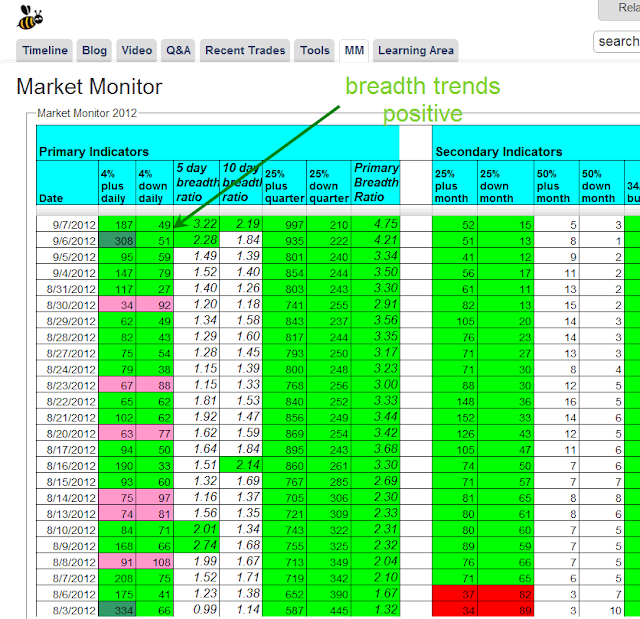


The market had a breakout last week. The breakout was preceded by 13 days of base. The breakout also coincides with market taking out multi year high.
Below the surface quality breakouts on momentum stocks are increasing. The breadth trends are positive for last couple of weeks.

domingo, 21 de octubre de 2012
Forex Multi year range breakout
Forex
The market had a breakout last week. The breakout was preceded by 13 days of base. The breakout also coincides with market taking out multi year high.
Below the surface quality breakouts on momentum stocks are increasing. The breadth trends are positive for last couple of weeks.
The market had a breakout last week. The breakout was preceded by 13 days of base. The breakout also coincides with market taking out multi year high.
Below the surface quality breakouts on momentum stocks are increasing. The breadth trends are positive for last couple of weeks.
jueves, 18 de octubre de 2012
Earn Why You Shouldn't Manage Your Friends' Money
Earn Why You Shouldn't Manage Your Friends' Money So you put away some nice returns this year - not too shabby. While you can't be blamed for bragging about good performance, it's not uncommon for friends to want a part of the action. What would you do if a friend asked you to make investments on his or her behalf? In this article we'll show you the highs and lows of investing for others. Taking Advantage of Your Financial Knowledge It's no surprise that your pals might want you to manage a couple of bucks for them. If you're pulling down decent returns and talking about your investing strategies, you've now become the go-to guy (or girl). These days, money talks and people who understand the financial world are getting a lot of respect as young people realize there's more to investing than they once thought. If you have financial knowledge, people who know you might view you as a very valuable commodity - a free money manager. All too often, the person asking you to invest his or her money is the person who knows a little something about investing - just enough to get into trouble. If you're nailing double-digit returns this year, why couldn't you repeat the performance year after year, right? The Problems with Investing for Others You may think that investing for someone else is just a way of helping out a friend, but the thing is, when you start investing for other people, particularly your friends, you enter a world of complications that you might not have foreseen when you started out. Unrealistic Expectations That friend of yours, the one who thinks that your 35% returns this year are going to happen next year as well, might be in for a nasty surprise when your picks make next to nothing. When you invest for friends, you have to deal with unrealistic expectations that can really put a damper on a relationship. If your friends wants you to invest for them, they likely don't understand all of the risks involved with investing, including not quite meeting the investment goals that they may have been projecting. Losing a Friend's Money Not meeting a friend's investing expectations could jeopardize your friendship, but falling short of your friend's projected returns could be a best-case scenario. When things go wrong, making some money is a lot better than losing money, which isn't an abstract concept for anyone who invests actively. When you bring money into a relationship, things can get uncomfortable pretty fast, especially when that money is hemorrhaging out of an investment account. Do you tell the friend to suck it up? Do you repay the person out of your pocket? Do you try to make up the difference with new picks? Really, there probably isn't a good way to deal with losing a friend's money and you should consider this risk before you agree to invest for anyone. Legal Matters Managing a friend's money is a sticky business and if you go through with it you may be breaking the law. Investment professionals must be registered with the Securities and Exchange Commission or have a federal license. They are heavily regulated by the government and by trade organizations like the National Association of Securities Dealers, for the protection of consumers. If you invest for a friend for compensation, you could be breaking laws that are in place to protect investors from people who aren't qualified to have discretionary control over others' accounts. Short End of the Stick Despite the drawbacks, investing for friends isn't always doomed to failure. With skill, smarts and a whole lot of luck, you might rake in the cash. If that's the case, you still have to consider whether or not your friend is taking advantage of you. Helping out a friend is nice, but when that help consists of making significant amounts of money for that person and getting little or nothing in return, you might be suffering from an off-balance relationship. What You Can Do for Friends Now that I've taken the wind out of your sails, and your friend's as well, there are things that you can do to help your friends' investments without burdening yourself with the substantial responsibility of investing someone else's money. One of the best ways to lend a hand is to help teach your friend about investing. Help Them Learn There are a lot of pitfalls out there for new investors. If you're lucky, you've been able to avoid quite a few of them or you learned how you should have gone about avoiding them. The benefit of your experience can be one heck of an asset to pass on to a friend and it won't cost either one of you personally or financially. Therefore, if you want to help your friends, work with them; show them how to analyze a financial statement, how to execute a trade online, how to look up business news, or how to find online resources. Investment Clubs Going farther still, there is a popular way to invest hands-on with friends without taking on the responsibility that an investment advisor would feel for a client - the investment club. The investment club consists of a group of people who vote to decide whether or not to buy or sell their group-owned investments. Investment clubs are great, because they allow a more personal approach with actual investments than just helping someone with investing concepts. These clubs will also give you a vested interest in performance of your friend's portfolio. If you're interested in starting an investment club, there are plenty of resources available, ranging from your broker to the internet. It's important to recognize that an investment club isn't just a couple of people who want to invest together - it's a formal (and legally defined) organization with members who have an equitable claim to their assets. This means you should look into the rules and laws that govern investment clubs where you live before joining or starting one yourself. The Bottom Line Investing for a friend usually isn't worth the amount of trouble it can cause. Money just isn't something you want to bring into a good friendship. In the end, by helping your friends invest on their own, you'll be doing them, and yourself, a much bigger favor.
martes, 16 de octubre de 2012
Signals GRU worth a bet
Signals


GRU: ELEMENTS MLCX Grains Index TR ETN had a high volume yesterday. Between mid June and to mid July it made 40% move in one month. So if the breakout works it has potential for big move.
lunes, 15 de octubre de 2012
Earn Citigroup cut investment bank bonuses by 30 percent: report
Earn Citigroup cut investment bank bonuses by 30 percent: report (Reuters) - Citigroup (NYSE:C - News) has cut bonuses for its investment banking division by about 30 percent on average, Bloomberg said, citing a person briefed on the matter. Some businesses within the securities and banking unit had bonuses reduced by as much as 70 percent, Bloomberg reported. Citigroup was not immediately available for comment. (Reporting by Abhiram Nandakumar in Bangalore; Editing by Steve Orlofsky)
Suscribirse a:
Entradas (Atom)